
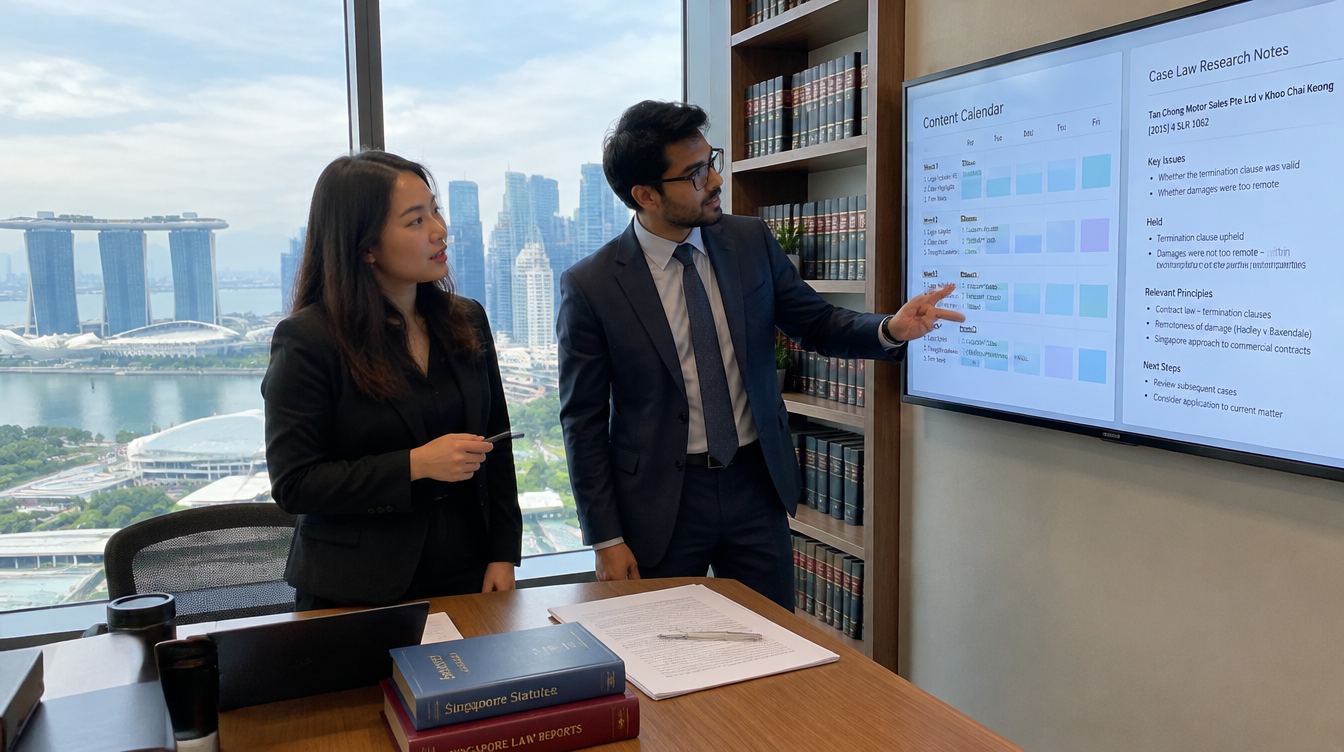
Content Marketing Strategy for Law Firms in Singapore
When Referrals Alone Stop Being Enough
A corporate client shortlisting counsel for a cross-border financing deal rarely begins with a phone call to a partner they already know. More often, someone on the client’s side has already searched for lawyers who have handled a similar transaction, skimmed two or three firms’ websites, and formed a rough view of who sounds like they understand the deal before anyone picks up the phone. For decades, Singapore’s legal profession built its reputation almost entirely through referrals, alumni networks and word of mouth within tightly connected industries.
That channel still counts for a great deal, but it no longer decides, by itself, who gets the first meeting. Firms that rely only on relationships built over the past decade are increasingly competing against practices that publish regularly: explainer notes on regulatory changes, sector guides for high-growth industries, and commentary on disputes that mirror what a prospective client is actually facing. None of this replaces personal relationships or courtroom skill. It does mean that when a client’s own search turns up nothing from a firm beyond a static bio page, that firm has already lost a small amount of ground before the conversation even starts.
The Line Singapore’s Publicity Rules Draw Around Marketing
Singapore’s legal profession operates under publicity rules that most other professional services firms do not have to think about. The Legal Profession (Professional Conduct) Rules 2015, and the Law Society’s advertising and publicity rules that interpret them, restrict touting, prohibit advertising that creates unjustified expectations about outcomes, and set limits on how a firm can describe itself as a specialist in a given area. A content marketing strategy for law firms in Singapore has to be built around these constraints from the outset, not bolted on afterwards as a compliance check. That changes which formats work: a firm can publish a detailed explainer on a new regulation, but it cannot imply that doing so guarantees a particular result for a reader considering legal action.
The Content Formats That Actually Build Pre-Engagement Trust
Within those boundaries, several content formats consistently earn attention from the people doing due diligence on a law firm, without straying into territory the publicity rules were written to prevent:
- Plain-language explainers on regulatory or legislative changes that affect a specific industry, written before competitors cover the same development.
- FAQ-style pages that address the practical questions a prospective client searches for, such as how a dispute process typically unfolds, without promising a particular outcome.
- Case commentary on publicly reported judgments, explaining what changed and why it is significant for businesses in a similar position.
- Sector-specific guides written for industries the firm actually practises in, such as fintech licensing or construction disputes, instead of generic overviews.
- Lawyer biographies that demonstrate depth through publications, speaking engagements and matter types handled, instead of adjectives such as “leading” or “top-tier” that the rules treat with suspicion.
What ties these formats together is that each one gives a prospective client something genuinely useful to read regardless of whether they ever instruct the firm. That is also what keeps the content on the right side of rules built to stop advertising that exists purely to create expectations a firm cannot necessarily meet.
Where This Fits Inside a Firm’s Broader Professional Credibility
This is not a concern unique to law firms. The same shift towards demonstrated expertise, instead of claimed expertise, is reshaping how clients evaluate every professional services firm in Singapore, from accountants to management consultants. The case for professional services content applies just as directly to legal practices, with the added complication that a law firm’s publicity rules are considerably stricter than an accounting firm’s. A litigation boutique and a large audit practice are both, in the end, selling judgement that is difficult to evaluate in advance, and both now get evaluated partly through what they choose to publish.
Writing Within the Rules Without Writing Something Nobody Reads
The instinct inside many firms is to route every piece of content through several rounds of partner review until nothing distinctive survives. That caution is understandable given what the publicity rules restrict, but it produces articles so hedged that they tell a reader nothing they could not already find on a government website. A workable alternative is to involve the person responsible for professional conduct compliance early, when a topic is chosen, instead of only at the final sign-off stage, so writers know from the start which claims and comparisons are off the table.
Firms that get this right tend to assign content to lawyers who already have a clear point of view on a subject, then edit for compliance rather than starting from a blank brief and hoping something useful emerges. A partner who has handled a dozen similar disputes usually has more to say about a recent judgment than a marketing team working from a press release, and that specificity is what separates a genuinely useful explainer from the kind of generic legal content search engines and readers both tend to ignore.
None of this needs to run at the pace of a consumer brand’s content calendar. A handful of well-researched pieces a year, timed to actual regulatory developments or notable judgments, will usually do more for a firm’s credibility than a high volume of thin updates that exist mainly to keep a blog from looking abandoned.
Conclusion
Singapore’s legal market is not about to abandon referrals, and it should not try to. What has changed is that referrals now get checked, quietly and online, before a prospective client ever replies to an introduction. A content strategy built carefully within the profession’s publicity rules gives a firm something substantive to be found with when that checking happens. If your firm wants a second opinion on which topics and formats fit both your practice areas and the rules that govern how you can talk about them, get in touch with our team.