
Content Marketing for Education Providers in Singapore
A working adult scrolling through course options on her phone during her commute is rarely comparing accreditation logos first. She is checking whether the training provider’s website answers the one question she actually has: will this course get her where she wants to go, and can she trust what the page is telling her about it.
Singapore’s private education and training sector has quietly become one of the most content-dependent industries in the country. SkillsFuture has turned millions of residents into active course shoppers, government subsidy rules shape what providers can and cannot say in their marketing, and a crowded field of competing institutions means the website, the email sequence and the course brochure often decide an enrolment before a prospective student ever calls the admissions line. Content marketing for education providers in Singapore now sits at the intersection of trust-building and compliance, and getting it right takes more than a polished prospectus.
Why Education Marketing in Singapore Runs on Trust, Not Just Rankings
Course rankings and accreditation badges still matter, but they rarely close a sale on their own. A prospective student comparing three CPE-registered training providers for the same diploma is really asking a quieter question: which of these three sounds like it understands people in my situation. Content that answers that question directly, through clear course breakdowns, honest timelines and graduate stories that read like real people instead of marketing copy, tends to outperform content built purely around keyword density or discount messaging.
The SkillsFuture Credit Rules Every Training Provider’s Content Must Respect
Singapore’s training providers operate under constraints most content teams in other industries never encounter. SkillsFuture Singapore’s publicity guidelines for SkillsFuture Credit are specific about what marketing content can and cannot say. Providers cannot describe a course as free or government-paid, cannot offer referral rewards, lucky draws, vouchers or other indirect incentives to encourage sign-ups, and cannot request Singpass credentials or other confidential details to help someone claim their credit. Content implying the Credit works only with one provider or course, when it actually applies across the full approved directory, breaches the same guidelines.
None of this limits a content programme so much as it directs it. The guidelines still require accurate disclosure of how a course’s fees are offset by SkillsFuture Credit or other subsidies, which gives a provider room to build genuinely useful fee breakdowns, FAQ pages and explainer content around funding mechanics instead of chasing the registration-day urgency tactics the rules were written to curb. Content built around clarity instead of persuasion tricks tends to survive a compliance review and still convert.
What Prospective Students Actually Search For
Search behaviour around courses looks less like a single decisive query and more like a slow accumulation of smaller ones, spread across weeks of comparison shopping. A content programme built to meet learners along that path tends to cover a consistent set of ground:
- Course duration and schedule against a working adult’s actual availability, not an idealised full-time timetable
- Entry requirements and prior learning recognition, particularly for career switchers without a directly relevant degree
- Genuine comparisons between similar courses at different providers, written honestly enough that a reader trusts the rest of the site
- Instructor backgrounds and teaching format, especially where a course mixes online and in-person components
- Post-course outcomes, including the kinds of roles and salary ranges graduates have actually moved into
Turning Outcomes Into Content Without Overpromising
Graduate outcomes are the strongest content a training provider has, and also the easiest to oversell. A single standout placement story, presented as typical, invites scepticism from exactly the audience a provider most wants to reach: people who have already been burned by inflated course marketing elsewhere. Outcome content earns more trust when it reports a believable range rather than a single headline figure, and when it names the specific skills or projects that made a difference instead of crediting the course in the abstract.
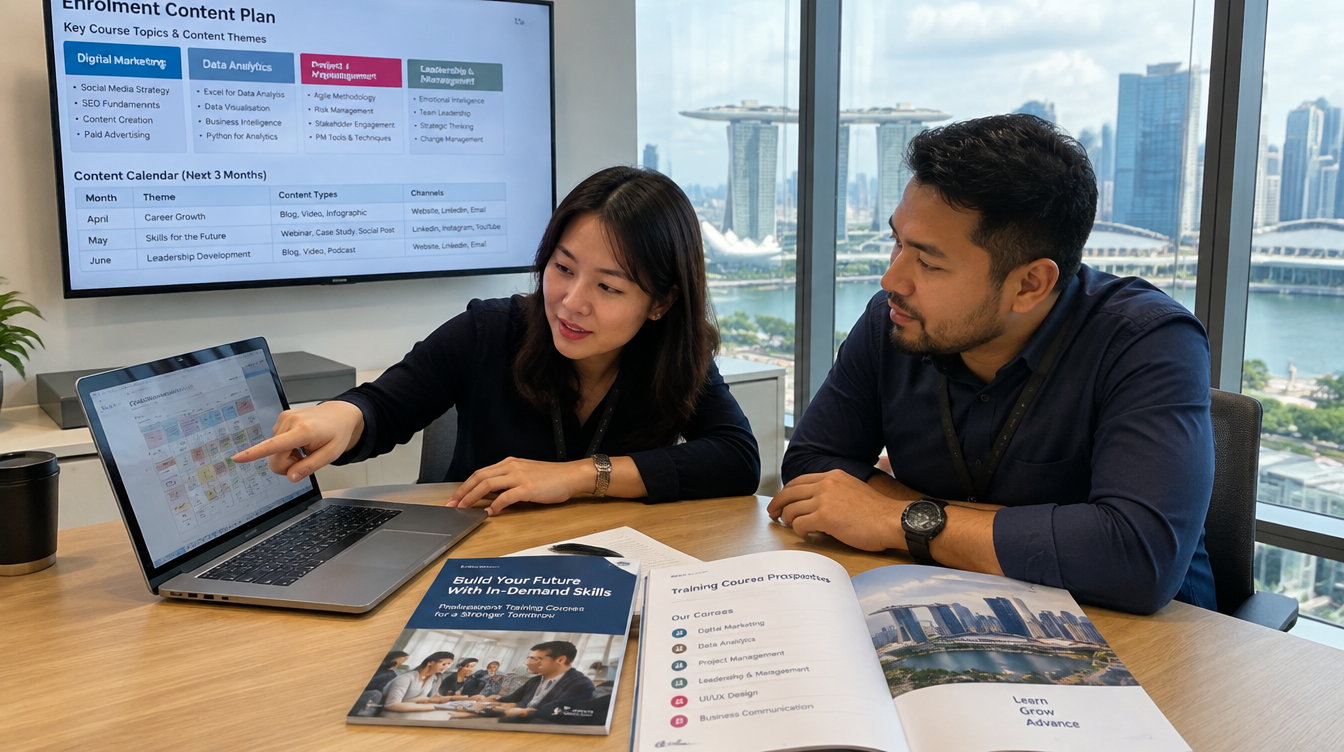
Case studies built around a graduate’s actual before-and-after situation, not just their job title change, tend to travel further on social media and in search results alike. A content calendar that pairs one detailed outcome story with several shorter testimonial snippets gives a provider enough material to sustain a steady publishing cadence without manufacturing new success stories every month.
Video adds another layer here that text alone cannot replicate. A two-minute clip of a graduate describing, in their own words, what the course actually changed about their work carries a credibility that a polished written quote rarely matches, and it travels well across a provider’s website, LinkedIn page and course landing pages alike.
Reaching Singapore’s Multiracial, Multigenerational Learner Base
Training providers serve an unusually wide range of learners by age, language and life stage, from a twenty-two-year-old exploring a first career pivot to a fifty-five-year-old parent retraining after a layoff. A single, uniformly worded course page rarely speaks equally well to both. The same thinking behind reaching Singapore’s diverse language communities applies just as directly to an education provider’s enrolment funnel: a Mandarin-speaking parent researching a diploma for their child and an English-speaking mid-career switcher researching the same course are unlikely to respond to identical messaging, even when the course itself does not change.
Building Content That Respects the Rules and Still Converts
A content programme built for Singapore’s education and training sector has to do two things most industries do not ask of their marketing: build real trust with sceptical, price-sensitive learners, and stay inside rules that exist specifically to stop the industry from over-promising. Providers that treat those as competing priorities tend to produce content that either reads as bland compliance copy or risks a regulatory headache. Providers that treat clarity itself as the selling point tend to do better on both counts.
Getting the balance right across course pages, email sequences and graduate stories takes sustained attention, not a single campaign. If building that kind of content programme sounds like more than your current team has time for, feel free to get in touch and we can talk through what a realistic starting point looks like.